

.jpg)
Heading 1
Heading 2
Heading 3
Heading 4
Heading 5
Heading 6
Lorem ipsum dolor sit amet, consectetur adipiscing elit, sed do eiusmod tempor incididunt ut labore et dolore magna aliqua. Ut enim ad minim veniam, quis nostrud exercitation ullamco laboris nisi ut aliquip ex ea commodo consequat. Duis aute irure dolor in reprehenderit in voluptate velit esse cillum dolore eu fugiat nulla pariatur.
Block Lorem ipsum dolor sit amet, consectetur adipiscing elit, sed do eiusmod tempor incididunt ut labore et dolore magna aliqua. Ut enim ad minim veniam, quis nostrud exercitation ullamco laboris nisi ut aliquip ex ea commodo consequat. Duis aute irure dolor in reprehenderit in voluptate velit esse cillum dolore eu fugiat nulla pariatur.
Ordered list
- Item 1
- Item 2
- Item 3
Unordered list
- Item A
- Item B
- Item C
Bold text
Emphasis
Superscript
Subscript

paragrph
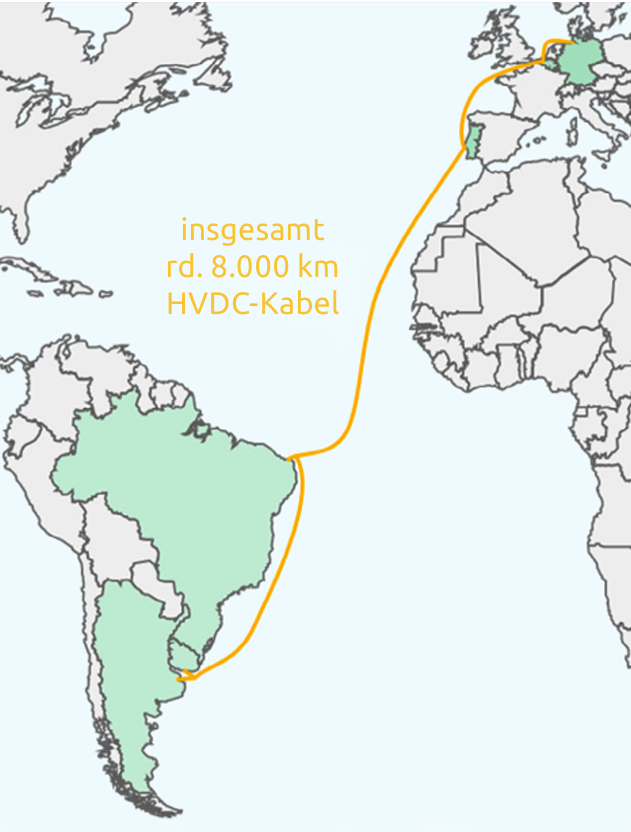
The concept is based on an approximately 8,000-kilometer subsea cable connecting Germany, Belgium, and Portugal with Brazil, Uruguay, and Argentina. It leverages the seasonal complementarity of the two hemispheres: when Europe is in winter and solar yields are low, South America supplies summer surpluses — and the system works in reverse during the European summer. An additional benefit is the three-to-four-hour time difference between the continents, which helps smooth daily peak loads.
The economic advantages of this approach are remarkable. Even under conservative assumptions, the system is at least five times more cost-effective than climate-neutral gas power plants running on hydrogen. Dispatchable capacity would prospectively cost between 68 and 77 euros per megawatt-hour. The seasonal complementarity between the hemispheres significantly reduces dark doldrums, partially eliminating the need for expensive backup capacity. Another important consideration is energy security through democratic partnership: all participating countries are democracies with market-based economies, providing a foundation of trust and long-term planning certainty.
With sufficient political will, the cable could be operational in the second half of the 2030s. The project is technically feasible, as comparable initiatives have already demonstrated. The Australian-Asian SunCable project, spanning more than 5,000 kilometers, impressively illustrates that infrastructure of this scale is achievable.
Heading 1
Heading 2
Heading 3
Heading 4
Heading 5
Heading 6
Lorem ipsum dolor sit amet, consectetur adipiscing elit, sed do eiusmod tempor incididunt ut labore et dolore magna aliqua. Ut enim ad minim veniam, quis nostrud exercitation ullamco laboris nisi ut aliquip ex ea commodo consequat. Duis aute irure dolor in reprehenderit in voluptate velit esse cillum dolore eu fugiat nulla pariatur.
Block quote
Ordered list
- Item 1
- Item 2
- Item 3
Unordered list
- Item A
- Item B
- Item C
Bold text
Emphasis
Superscript
Subscript
paragrph